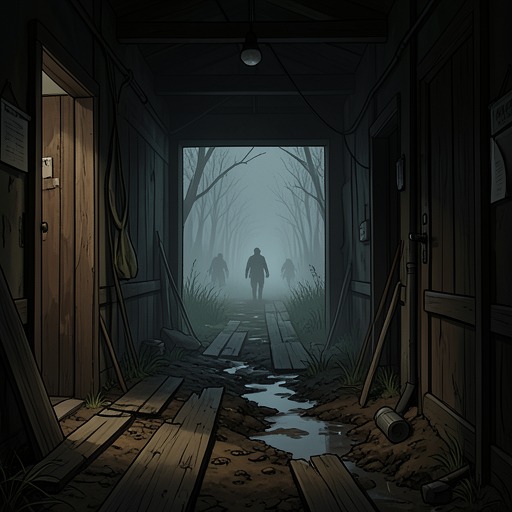
The Starving Time
House of LeavesThe Starving Time was the winter of 1609–1610 at the Jamestown Colony, a period of extreme deprivation that nearly destroyed the settlement and later became a haunting historical analogue for The house on Ash Tree Lane. Its decisive significance lies in the way the book turns a colonial crisis into an inherited pattern: exposure to an indifferent environment produces hunger, fear, disorientation, and finally a passage into an impossible space.
Historical Setting
The crisis followed the establishment of the Jamestown Colony by 105 colonists delivered to a marshy peninsula by the London Company on May 2, 1607. The settlement had already been weakened by pestilence, starvation, and repeated massacres carried out by native Indians. John Smith kept the village together until an injury compelled him to return to England, after which conditions deteriorated sharply.
The winter of 1609–1610 almost killed everyone who remained. The settlement survived only because Lord De la Wart arrived with supplies at a crucial moment; without that intervention, the survivors would have fled. Later, John Rolfe’s tobacco industry, his marriage to Pocahontas, and the designation of Jamestown as the Virginia capital helped secure the colony’s continuation. Yet the history remained marked by recurring violence: Nathaniel Bacon’s conflict with Sir William Berkeley left the village in flames, and after the capital moved to Williamsburg, the settlement decayed until little remained when park excavations began in 1934.
That physical disappearance gives The Starving Time a distinctive historical texture. The colonial site is described as a place whose marshland had obscured or consumed its monuments, so that environmental forces appear not merely as background but as agents in the destruction and concealment of memory. The past survives imperfectly, through fragments, damaged documents, and later acts of interpretation.
The Recovered Journal
The historical episode enters The Navidson Record through a journal supposedly preserved in the Lacuna Rare Books Library at Horenew College in South Carolina. The volume had first appeared at the Wishart Bookstore in Boston among crates of books removed from a nearby estate. A Boston University student noticed the penciled word “Wart” inside its damaged cover and bought it for $48.00, discovering that it was not written by De la Wart but had belonged to his library.
The journal was associated with three men who left the Jamestown Colony during The Starving Time in search of game. After traveling for several days, they reached an icy field and camped there for the night. In the following spring, two thawing bodies were found together with the document. The third man’s fate remained unexplained. The manuscript’s survival therefore binds physical remains to written testimony: two bodies return to the historical record, while one disappearance remains an open wound in it.
Most of the entries concern the search for food, severe weather, and the gradual recognition that cold and hunger are converging on death. The journal does not present starvation as one isolated catastrophe. It records an accumulation of failed searches, worsening weather, dwindling shelter, dreams, and the shrinking of the men’s world into an icy enclosure.
Weather, Hunger, and Perception
The dated entries make the decline measurable. On January 18, 1610, the men searched for deer or other game but found nothing, while Tiggs still believed their luck might change. The next entry records more snow and bitter cold, describes the place as terrible, and notes that a week had passed since they had seen a living thing. The storm prevented them from abandoning the site, while Verm was troubled by bad dreams.
On January 21, the storm had still not broken. Verm went hunting but returned within an hour. The wind produced a wicked sound in the woods, and the three men took comfort in it because the silence seemed more frightening. Verm dreamed of bones, while the diarist dreamed of the sun. These details show perception becoming unstable under deprivation: ordinary environmental sounds are converted into reassurance, silence becomes an active threat, and dreams supply the warmth, death, and meaning absent from waking life.
The next day the journal states plainly that the men were dying. There was no food and no shelter, while Tiggs dreamed that all the snow around them had turned red with blood. The entries thus move from failed optimism to bodily certainty, and from observation of the weather to symbolic hallucination. Cold and hunger do not simply endanger the men; they alter the terms by which the world can be understood.
The Discovery of the Stairs
The final entry is dated January 23, 1610. It consists of the startled announcement that stairs have been found. The discovery interrupts the journal’s established sequence of hunting, snow, cold, dreams, and approaching death. It introduces a structure where the preceding entries had established only an icy field and hostile woods.
The missing third body, the unexplained stairs, and the absence of any mention of such a discovery in Lord De la Wart’s personal journals preserve the episode as an unresolved archival mystery. De la Wart reportedly regarded the journal as an example of death’s madness and ordered the fragile relic burned, although the order was not carried out. The document instead passed through time until it reached the Boston bookstore and then the Lacuna Rare Books Library.
The stairs also create the historical echo on which the surrounding discussion depends. The journal may suggest that the extraordinary property associated with The Navidson Record existed nearly four centuries earlier, but it does not explain why that location mattered or how the colonial incident relates to the later house. Its evidentiary force is therefore double: it offers a possible historical precedent while refusing to resolve the relationship between the old site and the modern anomaly.
Narrative and Thematic Significance
The Starving Time is presented at a distance from the immediate action of The Navidson Record, which is preoccupied with The house on Ash Tree Lane and Will Navidson’s whereabouts rather than with seventeenth-century history. That lack of attention is itself meaningful. The colonial past is not part of the characters’ practical investigation, yet it supplies a deeper chronology for the house’s violence. History functions less as an answer than as a buried layer beneath the present.
The episode also connects the house to a wider succession of expeditions into the unknown. Ferdinand Magellan’s voyage, begun on September 20, 1519, exposed explorers to deprivation, fear, mutiny, and fatal violence; Henry Hudson’s fourth attempt to find the northwest passage ended with his crew frozen into Hudson Bay in 1610, amid dwindling provisions and what one account called a labyrinth without end. These precedents place The Starving Time within a recurring pattern in which exploration begins as an effort to map or master the unknown but becomes a confrontation with environmental forces and internal collapse.
That pattern extends into the modern narrative. A wind below seventy degrees under zero is described as cutting through clothing, cracking lips, freezing eyelashes, and making shelter an immediate necessity. At the hospital, Navidson’s core temperature falls to 83.7 degrees Fahrenheit; doctors raise it only to 85.3 degrees while the EKG continues to display the J wave associated with hypothermia. Across centuries, cold appears as a material force that strips away confidence and narrows existence to survival.
The recovered journal finally makes the threshold itself significant. Its men reach stairs just as the record of ordinary survival breaks down, while the modern house repeatedly turns domestic architecture into an unknowable depth. The Starving Time therefore joins colonial history, expeditionary failure, bodily extremity, and impossible architecture. It preserves the moment when hunger and cold have nearly erased the human world, yet a structure appears—possibly as refuge, possibly as trap, and possibly as the last distortion produced by minds confronting death.